D365 Custom Client Portal Framework
Standard Power Pages are excellent for rapid, low-complexity sites. But when you need a high-performance, fully custom web application that interacts with Dataverse, the standard "configuration-first" approach often hits a ceiling.
Our D365 Client Portal is a custom framework designed for scenarios where UX requirements and business logic complexity outgrow standard Power Pages. It provides a secure, modern web interface for your clients to interact directly with your CRM data, without the constraints of Liquid templates or Power Platform configuration.
Enterprise-Grade Authentication
Security is the foundation of the client portal. We don't force you into a proprietary login flow. The portal supports any OpenID Connect (OIDC) or OAuth 2.0 provider, allowing you to decouple identity management from the application layer.
- Azure AD B2C: The standard for external customer identity.
- OAuth 2.0 Providers: Google, Microsoft, LinkedIn, Facebook.
- Enterprise IDPs: Okta, Auth0, PingIdentity.
- Custom Authentication Store: We can integrate with almost any identity provider.
Once authenticated, the user’s context is securely mapped to a Contact record in Dataverse, ensuring row-level security is applied to every API call.
Full CRUD Capability with Dataverse
This is not a read-only dashboard. It is a transactional application.
- Direct Write-Back: Clients can update profile data, submit complex multi-step forms, or manage case data. Changes are committed to Dataverse via the Web API in real-time.
- Server-Side Validation: All logic is validated against Dataverse plugins and business rules to ensure data integrity.
- Optimized Payload: Unlike standard portals that often load heavy entity forms, our custom endpoints fetch only the specific payloads required, significantly reducing latency.
Architecture Comparison: Custom Portal vs. Power Pages
For an architect, the decision often comes down to control vs. convenience. Here is how our custom solution stacks up against the standard Power Pages offering.
| Feature | Standard Power Pages | Custom Client Portal Solution |
|---|---|---|
| Tech Stack | Liquid Templates, Low Code | Blazing fast C# and Modern Web technologies (React, Tailwind, or modern Server Rendered Pages). |
| Development | Portal Management App & Design Studio. | Visual Studio / VS Code. Full CI/CD pipelines. |
| API Limits | Bound by standard Power Platform request limits. | Optimized calls; easier to cache and throttle. |
| UI/UX Control | constrained by template structures. | Pixel-perfect control. No fighting the DOM. |
| Latency | Server-side rendering can be slow on complex forms. | Fast client-side rendering; feels like a native app. |
Developer Experience & CI/CD
We know that "citizen developer" tools can frustrate professional engineers. This solution is built to fit into a standard SDLC.
- Source Control: The entire portal is standard code (.NET Core, React). You can store it in Git, review PRs, and manage versions properly.
- Deployment: Deploy using standard Azure DevOps or GitHub Actions pipelines. No need to use the Power Platform CLI to migrate portal configuration records between environments.
- Local Debugging: Run the portal on localhost pointing to a Dev Dataverse instance. Step through code, inspect network requests, and debug UI issues instantly without waiting for server cache invalidation.
- Widespread Support: Any partner that has C# capabilities can support this project.
Modern UI/UX
Common Use Cases
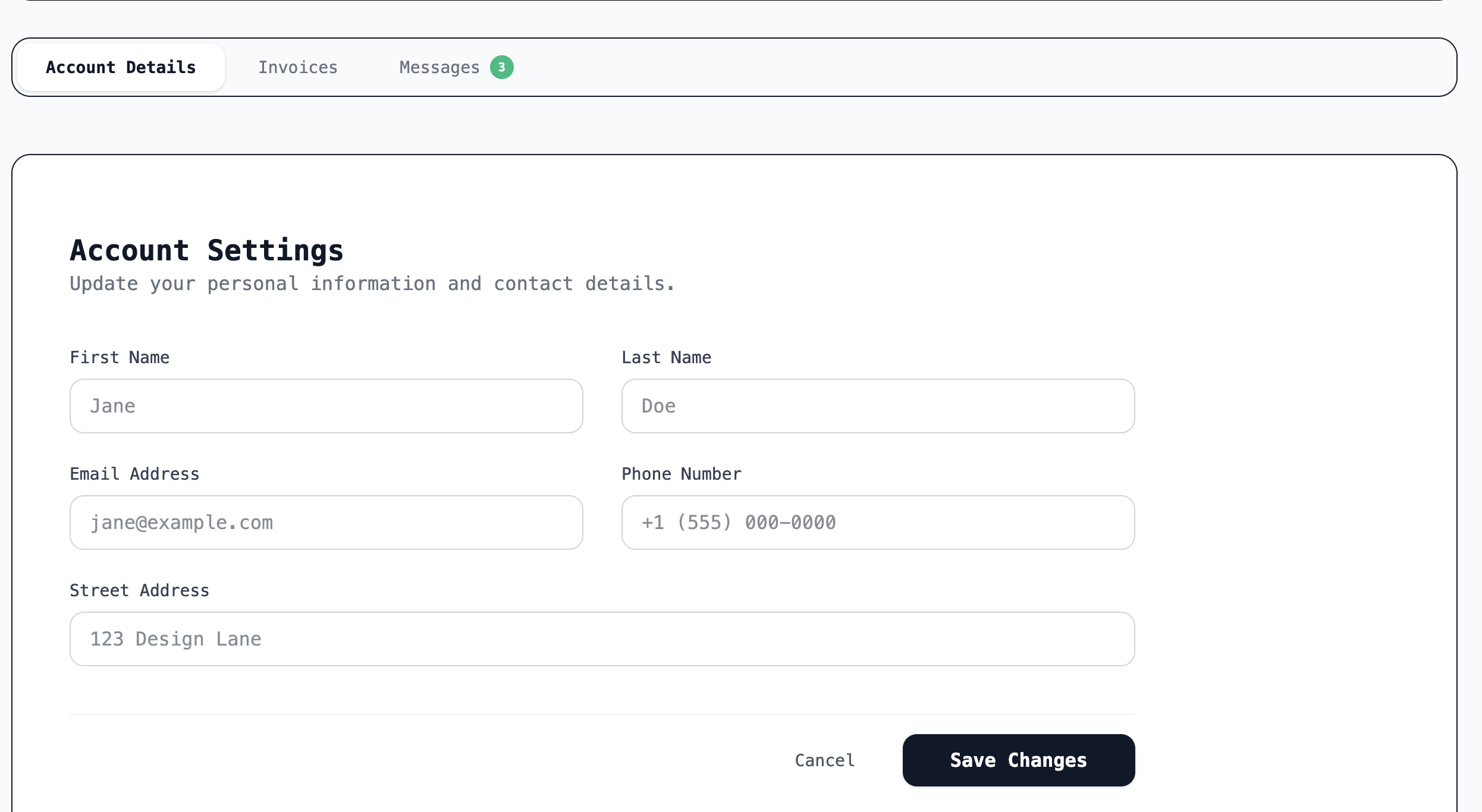
- Self-Service Profile Management: Allow customers to update address, customer details, communication preferences, or any custom table.
- Sign-up: Allow customers to sign-up and provide details which automatically creates a dataverse contact record.
- Complex Application Forms: Multi-page wizards with conditional logic that is difficult to implement in standard Entity Forms.
- Document Uploads: Securely upload files to Azure Blob Storage with metadata reference stored in Dataverse.